
Vascular Remodeling of the Lumbosacral Enlargement
This illustration was produced with Dr. Phillipe Gailloud from the Department of Interventional Neuroradiology. It is intended to accompany a manuscript which will be submitted for publication.
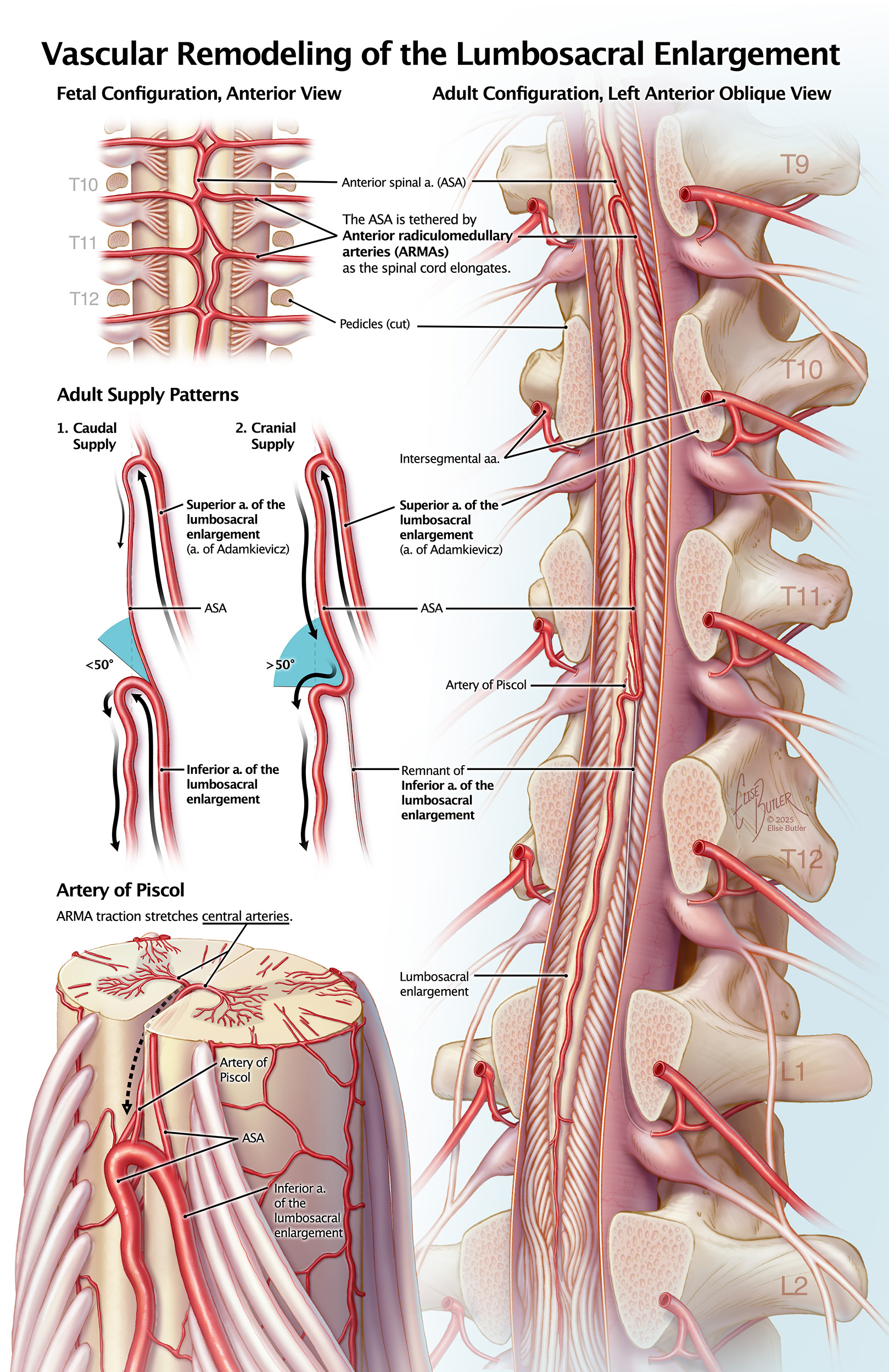
During development, the spinal cord elongates less than the spinal column, leading to its “ascent.” The primary vascular supply to the spinal cord is from anterior radiculomedullary arteries, ARMAs, which occur at each level in the fetal spinal cord and are pared down during development. The remaining ARMAs are pinned under the pedicles as the spinal cord ascends, producing traction on the anterior spinal artery (ASA) which can lead to deflections.
The lumbosacral enlargement is usually supplied by one ARMA – most frequently, the superior artery of the lumbosacral enlargement, or artery of Adamkievicz. An inferior artery of the lumbosacral enlargement is seen less frequently. The inferior artery may be patent, or may atrophy and become a tether, depending on the angle of ASA deflection. Therefore, the angle of ASA deflection determines whether the superior or inferior artery, or both, supply the lumbosacral enlargement.
ASA deflection may reveal the central arteries, which are stretched by ARMA traction. These “Arteries of Piscol” may appear to be fenestrations on radiographs.
During development, the spinal cord elongates less than the spinal column, leading to its “ascent.” The primary vascular supply to the spinal cord is from anterior radiculomedullary arteries, ARMAs, which occur at each level in the fetal spinal cord and are pared down during development. The remaining ARMAs are pinned under the pedicles as the spinal cord ascends, producing traction on the anterior spinal artery (ASA) which can lead to deflections.
The lumbosacral enlargement is usually supplied by one ARMA – most frequently, the superior artery of the lumbosacral enlargement, or artery of Adamkievicz. An inferior artery of the lumbosacral enlargement is seen less frequently. The inferior artery may be patent, or may atrophy and become a tether, depending on the angle of ASA deflection. Therefore, the angle of ASA deflection determines whether the superior or inferior artery, or both, supply the lumbosacral enlargement.
ASA deflection may reveal the central arteries, which are stretched by ARMA traction. These “Arteries of Piscol” may appear to be fenestrations on radiographs.